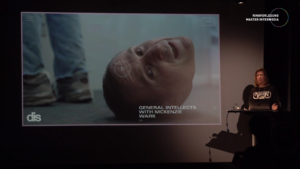
Das Internet, die enorme Steigerung der Rechenleistungen und die Digitalisierung verändern kulturelle Praxen online wie offline und haben so weitreichende wie durchgreifende Auswirkungen auf die Anforderungen des Alltags. Gerade die Bilder scheinen dabei eine besondere Rolle zu spielen: Ihr Auftreten bestimmt, begleitet und bedingt kulturelle, wie politische Prozesse. Als Selfie, Erinnerungsstück, Beweisfoto, Clickbait, Internetmem, Fototapete und Bildschirmhintergrund agiert das Einzelbild in vielfältigen Beziehungen zu anderen Bildern. Zwischen Meme-Engineering, Mona Lisa und Cat-Content erkundet dieser Vortrag strukturelle Fragen am Bild der Gegenwart.
Die These: Als geschäftsführende kulturelle Einheit der Gegenwart verstanden, eignet sich gerade das Bild für eine eingehende Untersuchung, um die kleinteiligen und vielfältigen Veränderungen der Gegenwart vor größerem Maßstab anschaulicher begreifen zu können.
Konstanze Schütze, Jun.-Prof., Dr., ist Kuratorin und Kunstpädagogin. Sie arbeitet und forscht in der der Kunstvermittlung, bildwissenschaftlichen Medientheorie und ist involviert in eine inklusive und kritische pädagogische Praxis zwischen Hochschule, Schule und Museum. Aktuell ist Sie Juniorprofessorin für Kunst Medien Bildung am Institut für Kunst & Kunsttheorie der Universität zu Köln. Sie ist Mitgründerin des kollaborativen Forschungsprojekts »Dear Humans, …« (Kustodie der TU Dresden), Koproduzentin/Kuratorin des queerfeminitischen Festivals für postdigitale Kultur im Performativen dgtl fmnsm (Europäisches Zentrum der Künste Hellerau), des Galerieprojektes storecontemporary.com (Dresden), sowie der Agentur für Kunstvermittlung agency art education (Kassel). Arbeitsschwerpunkte: Bildung mit dem Daumen, Bildlichkeit nach dem Internet (Promotion), Art and the Postdigital Condition, Updates für eine inklusive und kritische Kunstvermittlung nach dem das Internet neu wahr. Projekte: storecontemporary.comI agencyart.educationI methodsofart.netI piaer.net I digitalfeminism.net/2018
Bildcredits: Paul Barsch
The New York collective DIS (Lauren Boyle, Marco Roso, Solomon Chase, David Toro) transforms knowledge and discourse into experiences. Following the credo: To change the world we must change our ability to understand it. DIS radically confront the complexity of the present at eye level.
For nearly a decade now, DIS has continuously embraced, engaged, and reinvented important new platforms for the production, dissemination, and discussion of contemporary culture – all of which reimagine one format or another. Through it’s own unique platforms, and curatorial projects, DIS enhances and amplifies the possibilities and capabilities of art and its role in the artistic, commercial, educational, and public spheres – folding all into one. Today, DIS is focused on dis.art. While remaining true to the novel approaches to critical inquiry that defined life as a magazine, DIS is focused on redefining entertainment and education through its new streaming platform – dis.art.
Lauren Boyle lives and works in New York City. She is a co-founder of the collective DIS, whose cultural interventions are manifest across a range of media and platforms, from site-specific exhibitions to ongoing online projects. The early iteration of DIS was DIS Magazine (2010–2017), which produced editorials and published mixtapes alongside discourse-heavy essays on topics like data and the post-contemporary. In 2018 the collective transitioned platforms from an online magazine to a video streaming edutainment platform – dis.art – narrowing in on the future of education and entertainment.
The New York collective DIS (Lauren Boyle, Marco Roso, Solomon Chase, David Toro) transforms knowledge and discourse into experiences. Following the credo: To change the world we must change our ability to understand it. DIS radically confront the complexity of the present at eye level. For nearly a decade now, DIS has continuously embraced, engaged, and reinvented important new platforms for the production, dissemination, and discussion of contemporary culture – all of which reimagine one format or another. Through it’s own unique platforms, and curatorial projects, DIS enhances and amplifies the possibilities and capabilities of art and its role in the artistic, commercial, educational, and public spheres – folding all into one. Today, DIS is focused on dis.art. While remaining true to the novel approaches to critical inquiry that defined life as a magazine, DIS is focused on redefining entertainment and education through its new streaming platform – dis.art.
Lauren Boyle lives and works in New York City. She is a co-founder of the collective DIS, whose cultural interventions are manifest across a range of media and platforms, from site-specific exhibitions to ongoing online projects. The early iteration of DIS was DIS Magazine (2010–2017), which produced editorials and published mixtapes alongside discourse-heavy essays on topics like data and the post-contemporary. In 2018 the collective transitioned platforms from an online magazine to a video streaming edutainment platform – dis.art – narrowing in on the future of education and entertainment.
Bildcredits
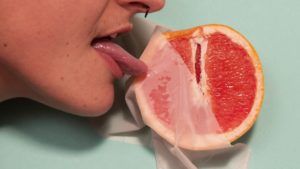
The New Wholesome, DISimages, 2013
Courtesy DIS
Today’s educational platforms are conceived and built online. After curating the 9th Berlin Biennale for Contemporary Art, and dedicating 7 years to DIS Magazine, DIS morphed into a radical streaming platform for education – dis.art – producing and publishing original series and docs by leading artists and thinkers about critical issues: the future of money and inequality; how the »liberal« and the »democratic« are pulling apart; mass entrepreneurship in China; post-nationality and citizenship; media theory in the age of trolling; the future of global food sustainability; the ethics of artificial intelligence; and the intersection of sexuality, race, and the environment, just to name a few. Michel Serres (Thumbelina, 2013) tenderly speaks of the little thumbs; meaning those who essentially gain access to the world through their thumbs. Technology’s promise of productivity is now to keep us unproductive, scrolling and tapping to keep from doing, sleek apps hiding a complexity so great no single person can grasp. Dis.art is the result of a change in attitude towards the present, and aims to meet the demands of contemporary social, political, and economic complexity at eye level.
Lauren Boyle lives and works in New York City. She is a co-founder of the collective DIS, whose cultural interventions are manifest across a range of media and platforms, from site-specific exhibitions to ongoing online projects. The early iteration of DIS was DIS Magazine (2010–2017), which produced editorials and published mixtapes alongside discourse-heavy essays on topics like data and the post-contemporary. In 2018 the collective transitioned platforms from an online magazine to a video streaming edutainment platform – dis.art – narrowing in on the future of education and entertainment.
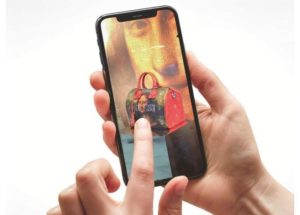
Bildcredits: Untitled, from Thumbs that Type and Swipe, 2018, Courtesy DIS
The New York collective DIS (Lauren Boyle, Marco Roso, Solomon Chase, David Toro) transforms knowledge and discourse into experiences. Following the credo: To change the world we must change our ability to understand it. DIS radically confront the complexity of the present at eye level.
For nearly a decade now, DIS has continuously embraced, engaged, and reinvented important new platforms for the production, dissemination, and discussion of contemporary culture – all of which reimagine one format or another. Through it’s own unique platforms, and curatorial projects, DIS enhances and amplifies the possibilities and capabilities of art and its role in the artistic, commercial, educational, and public spheres – folding all into one. Today, DIS is focused on dis.art. While remaining true to the novel approaches to critical inquiry that defined life as a magazine, DIS is focused on redefining entertainment and education through its new streaming platform – dis.art.
Lauren Boyle lives and works in New York City. She is a co-founder of the collective DIS, whose cultural interventions are manifest across a range of media and platforms, from site-specific exhibitions to ongoing online projects. The early iteration of DIS was DIS Magazine (2010–2017), which produced editorials and published mixtapes alongside discourse-heavy essays on topics like data and the post-contemporary. In 2018 the collective transitioned platforms from an online magazine to a video streaming edutainment platform – dis.art – narrowing in on the future of education and entertainment.
Bildcredits: The New Wholesome, DISimages, 2013, Courtesy DIS
(see below for English version)
Im Kontext des Seminars und der Lehrer*innenfortbildung „Postdigitale Medienkultur in der Schule: aktuelle Kunst meets Lehrplan.“ und des Semesterthemas „Decolonial Practices and Sensibilities“ wird am Institut für Kunst & Kunsttheorie im WiSe 19/20 eine Reading Group angeboten. Diese basiert auf dem Format der Young Girl Reading Group, einem Projekt der Künstler*innen Dorota Gawęda und Egle Kulbokaitė. Initiiert und begleitet durch Konstanze Schütze und Kristin Klein (Universität Köln), werden gemeinsam wissenschaftliche Texte zu queerer Theorie, Science Fiction und dem digitalen Imaginären gelesen und diskutiert. Textvorkenntnisse sind nicht erforderlich. Die Lesesessions werden im Abschluss mit kleinen entspannenden Yoga-Einheiten (durch YouTuber*innen angeleitet) abgerundet. Bitte Yogamatte mitbringen, wenn vorhanden.Termine/Texte:
Termin 1: 07.11. (17:45-19.15) – Grounding in History
> Donna Haraway, Manifest für Cyborgs, 1985 (DT)
> „Cyborg“ unter: http://cyborganthropology.com/Main_Page
Termin 2: 28.11. (17:45-19.15) – Situating in the Present
> Laboria Cuboniks, Xenofeminist Manifesto, 2015 (DT)
> Helen Hester: Xenofeminism, in: Rosi Braidotti/ Maria Hlavajova (Hg.): Posthuman Glossary, Bloomsbury 2018
Termin 3: 12.12. (17:45-19.15) – Staying with the Trouble
> Luciana Parisi. Introduction. In: Abstract Sex,
> Donna Haraway. Unruhig Bleiben (DE)
Termin 4: 09.01. (17:45-19.15) – Speculating on the Future
> Irmgard Emmelhainz. Decolonial Love. in: Eflux, Journal #99 – April 2019. Online: https://www.e-flux.com/journal/99/262398/decolonial-love///EnglishIn the context of the seminar „Postdigitale Medienkultur in der Schule: aktuelle Kunst meets Lehrplan“ and the semester topic „Decolonial Practices and Sensibilities“ there will be a reading group at the Institute for Art & Art Theory in the winter term 19/20. It is based on the format of theYoung Girl Reading Group, a project of artists Dorota Gawęda and Egle Kulbokaitė. Initiated and jointly organized by Konstanze Schütze and Kristin Klein (University of Cologne), scientific texts on queer theory, Science Fiction and the digital imaginary will be read and discussed together. Previous text knowledge is not required. The reading sessions will be accompanied by short and relaxing yoga sessions (guided by YouTube videos). Please bring your own yoga mat, if available.
Dates/Texts
07.11. (17:45-19.15) – Grounding in History
> Donna Haraway. A Cyborg Manifesto, 1985 (EN)
> „Cyborg“ unter: http://cyborganthropology.com/Main_Page
28.11. (17:45-19.15) – Situating in the Present
> Laboria Cuboniks, Xenofeminist Manifesto, 2015 (EN). Online: https://www.laboriacuboniks.net/
> Helen Hester: Xenofeminism, in: Rosi Braidotti/Maria Hlavajova (Hg.): Posthuman Glossary, Bloomsbury 2018
12.12. (17:45-19.15) – Staying with the Trouble
> Luciana Parisi. Introduction. In: Abstract Sex,
> Donna Haraway. Staying with the Trouble (EN)
09.01. (17:45-19.15) – Speculating on the Future
> Irmgard Emmelhainz. Decolonial Love. in: Eflux, Journal #99 – April 2019. Online: https://www.e-flux.com/journal/99/262398/decolonial-love/KontaktKonstanze Schütze: k.schuetze@uni-koeln.deKristin Klein: kristin.klein@uni-koeln.deBildcredits: Katja Illner ©NRW-Forum DüsseldorfTags: Decolonization, Reading Group, Yoga, Young Girl Reading Group
Kunstpädagogische Positionen // 30.10.2019
Empfehlung: Schauen Sie sich zum besseren Verständnis des Vortrags zuvor die Videoarbeit „Premium Connect“ von Tabita Rezaire online an: vimeo.com/247826259 (13:04min)
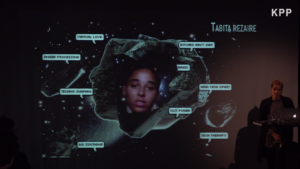
Tabita Rezaires Kunst ist als radikale Annäherung sehr diverser Perspektiven zu verstehen und dient als Vorlage für eine mehrdimensionale Betrachtung aktueller Transformationsdynamiken im Kontext fortgeschrittener Digitalisierung. Um der Komplexität heutiger Weltmodelle in hyperindividualisierten und gleichzeitig global vernetzten Gesellschaften zu begegnen, widmet sich die Künstlerin unterschiedlichen Wissensformen und Erkenntnisweisen, darunter Beispiele aus Mikrobiologie und Informatik genauso wie affektive Strukturen, verkörpertes Wissen, animistisches Denken und spirituelle Praxen.
Anhand der Arbeit Premium Connect (2017) lassen sich Verbindungen von Naturwissenschaft, Technologie und Spiritualität skizzieren, in der Digitalisierung als komplexe und tief mit soziokulturellen, politischen und ökonomischen Strukturen verflochtene Prozesse thematisiert werden. Gestützt durch kulturwissenschaftliche und philosophische Theoretisierungen, die die Dichotomie von Natur- und Geisteswissenschaft längst hinter sich gelassen haben, tun sich für die Kunstpädagogik, verstanden als genuin interdisziplinäre Disziplin, interessante Forschungsperspektiven auf – besonders hinsichtlich einer sogenannten Post-Internet Arts Education und deren Erweiterung um queere, postkoloniale Perspektiven.
MONTHLY lectures ist ein öffentliches Archiv des Instituts für Kunst & Kunsttheorie der Universität zu Köln, das die regelmäßigen Vorträge am Institut online versammelt. Formatübergreifend werden Symposien, Tagungen, KünstlerInnenpräsentationen, kunstpädagogische Positionen und Vorträge aus den angrenzenden gestalterischen und wissenschaftlichen Disziplinen nach Kategorien und Themen sortiert abgebildet und für ein breites Publikum und individuelle Forschung zugänglich gemacht.
Kristin Klein ist wissenschaftliche Mitarbeiterin am Institut für Kunst & Kunsttheorie der Universität zu Köln, aktuell im Projekt Post-Internet Arts Education Research. Sie studierte Kulturwissenschaft, Kunstpädagogik, Philosophie, Germanistik und Bildungswissenschaften an der Humboldt-Universität zu Berlin, der TU Dresden und der Boston University. Forschungsschwerpunkte: Kunst nach dem Internet, Kunstpädagogik im Kontext postdigitaler Kulturen. Zusammen mit Torsten Meyer, Gila Kolb und Konstanze Schütze ist sie Herausgeberin des Workbook Arts Education (myow.org: seit 2018), mit Willy Noll veröffentlichte sie Postdigital Landscapes (zkmb.de: 2019). Web: kristin-klein.net
Credits:
Aufzeichnung und Postproduktion:
MBR – Medienbildungsraum mit Merle Ballermann, Julia Goltermann, Elias Müller und Marlène Tencha
Organisation:
Martin Brand, Eva Hegge, Carolin Jakob und Dshamilja Nebgen
Leitung:
Prof. Dr. Torsten Meyer
Produziert von:
Universität Köln, Institut für Kunst & Kunsttheorie
Imprint
© 2020 kunst.uni-koeln.de/monthly/
Institut für Kunst & Kunsttheorie, Prof. Dr. Torsten Meyer
Posthumanistische Medienbildung?
Bildungstheoretische Positionen nach Anthropozentrismus und Humanismus
Interdisziplinäres Symposium am 25. und 26.10.2019
Ort: Institut für Kunst und Kunsttheorie, Universität zu Köln
Vortrag:
Prof. Dr. Estrid Sørensen
Techniken der Selbstbestimmung: Ein Tanz von Hingabe und Care
Das Symposium wurde von Jun.-Prof. Dr. Patrick Bettinger (Universität zu Köln),
Prof. Dr. Manuel Zahn (Universität zu Köln) und Dr. Harald Gapski (Grimme-Institut)
durchgeführt und vom Grimme-Forschungskolleg an der Universität zu Köln gefördert.
Posthumanistische Medienbildung?
Bildungstheoretische Positionen nach Anthropozentrismus und Humanismus
Interdisziplinäres Symposium am 25. und 26.10.2019
Ort: Institut für Kunst und Kunsttheorie, Universität zu Köln
Vortrag:
Prof. Dr. Oliver Krüger
Der futurologische Imperativ. Die Überwindung des Menschen im technologischen Posthumanismus
Das Symposium wurde von Jun.-Prof. Dr. Patrick Bettinger (Universität zu Köln),
Prof. Dr. Manuel Zahn (Universität zu Köln) und Dr. Harald Gapski (Grimme-Institut)
durchgeführt und vom Grimme-Forschungskolleg an der Universität zu Köln gefördert.
Posthumanistische Medienbildung?
Bildungstheoretische Positionen nach Anthropozentrismus und Humanismus
Interdisziplinäres Symposium am 25. und 26.10.2019
Ort: Institut für Kunst und Kunsttheorie, Universität zu Köln
Vortrag:
PD Dr. Stefan Herbrechter:
Menschsein ver/lernen? „Verwilderungstendenzen“ und Posthumanistische Remediation
Das Symposium wurde von Jun.-Prof. Dr. Patrick Bettinger (Universität zu Köln),
Prof. Dr. Manuel Zahn (Universität zu Köln) und Dr. Harald Gapski (Grimme-Institut)
durchgeführt und vom Grimme-Forschungskolleg an der Universität zu Köln gefördert.